You know the basics. Now it's time to actually make music.
Start with Rhythm, Not Melody
This is counterintuitive. Most beginners want to play melodies right away. But rhythm is the foundation.
If your rhythm is solid, even simple notes sound musical. If your rhythm is off, even beautiful melodies sound wrong.
Exercise: The basic pulse
- Play the ding (center note) on beat 1
- Play a tak (slap on the shoulder) on beats 2, 3, 4
- Repeat: DING - tak - tak - tak - DING - tak - tak - tak
- Keep it slow and steady. Use a metronome at 60 BPM if you have one
Do this for 5 minutes. It sounds boring. It builds everything.
Your First Melody Pattern
Once your rhythm feels steady, try adding melody notes:
Exercise: Two-note melody
- Pick any two adjacent tone fields
- Alternate between them: note A - note B - note A - note B
- Keep a steady rhythm
- Once comfortable, try: A - A - B - A (creates a simple phrase)
You just wrote your first melody.
The 3-Note Loop
Exercise: Three-note pattern
Pick three notes that are next to each other. Play them in a loop:
1-2-3, 1-2-3, 1-2-3...
Then try reversing: 3-2-1, 3-2-1...
Then mix: 1-2-3, 3-2-1, 1-2-3, 3-2-1...
You'll be surprised how musical this sounds on a handpan. The pentatonic scale makes everything work.
Adding the Ding
The ding (center note) is your anchor — like the bass in a band. Use it to ground your melodies:
- Play the ding every 4 beats (beat 1)
- Fill beats 2-4 with tone field notes
- Pattern: DING - note - note - note - DING - note - note - note
This creates structure. Your playing goes from "random pretty notes" to "actual music."
How to Practice
The #1 mistake: Playing randomly for an hour and calling it "practice." It's fun but you don't improve. Structured practice does.
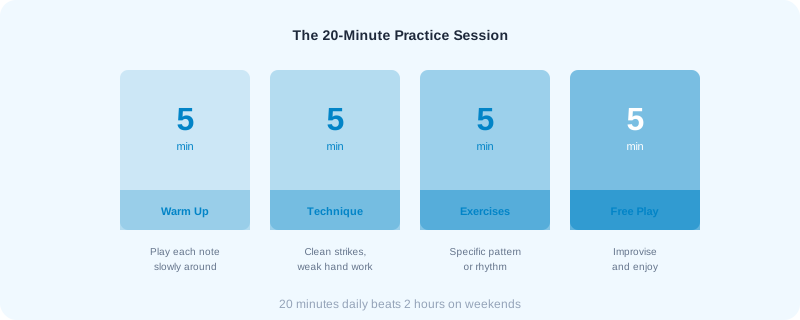
A good 20-minute practice session:
| Time | What to do |
|---|---|
| 0-5 min | Warm up: play each note slowly around the circle |
| 5-10 min | Technique: practice clean strikes, work on weak hand |
| 10-15 min | Exercises: work on a specific pattern or rhythm |
| 15-20 min | Free play: improvise and have fun |
Practice daily, not long. 20 minutes every day beats 2 hours on weekends. Your muscle memory builds through consistency, not marathon sessions.
Learning from Malten
Recommended resource
Malte Marten (Malten) is one of the best handpan teachers I've found. His approach is:
- Feel-based rather than theory-heavy
- Clear demonstrations you can follow along with
- Structured progressions from simple to complex
- Patient teaching style that doesn't rush
Search for his tutorials on YouTube or check his website for courses. If you only follow one teacher, make it him.
Common Beginner Frustrations
"I keep muting the notes." You're leaving your fingers on the surface too long. Practice the bounce. Strike and lift immediately.
"My left hand is useless." Normal. Spend extra time on your weak hand during practice. It catches up faster than you'd think.
"Everything sounds the same." You're probably playing at the same volume and speed. Try playing softer. Try playing slower. Dynamics create interest.
"I don't know what to play." Follow a structured lesson (Malten's courses are great for this). Random noodling is fun but doesn't build skills.
After 2-3 weeks of daily practice, you'll notice a shift. Your hands know where the notes are. Your strikes are cleaner. You start hearing patterns. That's when it gets really fun.
Let's talk about what comes after the basics.