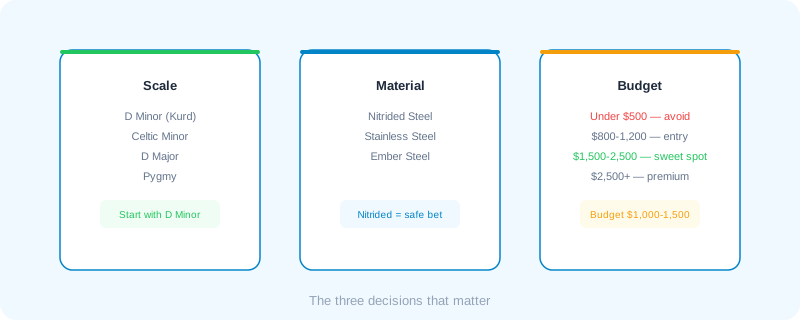
This is where most beginners get stuck — and where mistakes are expensive.
A handpan is a significant purchase. Even entry-level instruments start around $800-1,000. Good ones run $1,500-2,500. Premium makers charge $3,000+.
Don't rush this decision. A bad handpan will frustrate you and might turn you off the instrument entirely.
Choosing a Scale
The scale determines the mood and character of your handpan. Here are the most popular beginner scales:
Best scales for beginners
- D Minor (Kurd) — the most popular scale. Melancholic, versatile, huge community and learning resources
- Celtic Minor — similar to Kurd but with a slightly different feel. Great for melodic playing
- D Major — bright, happy, uplifting. Good if you want a positive sound
- Pygmy — deep, mystical, meditative. Beautiful but less versatile
My recommendation: Start with D Minor (Kurd) unless you strongly prefer a different mood. Most tutorials, especially Malten's, use this scale. You'll find the most learning content for it.
Number of Notes
Handpans come with different numbers of tone fields:
- 8-9 notes — standard. Enough for most playing styles. Easier to learn
- 10-12 notes — more range but harder to navigate. More expensive
- 13+ notes (mutants/bottom notes) — advanced. Not for beginners
Start with 9 notes. More notes means more options, but also more confusion when you're starting out.
Materials
| Material | Sound | Sustain | Rust Resistance | Best for |
|---|---|---|---|---|
| Nitrided steel | Warm, mellow | Shorter | Moderate (needs oiling) | Rhythmic/fast playing |
| Stainless steel | Bright, complex | Long | High (rust-proof) | Sustained melodic playing |
| Ember steel | Warm, controlled | Long but controlled | High | Beginners (forgiving touch) |
Ember Steel is actually a marketing name by Ayasa Instruments for a specific stainless steel grade. It's praised for being very responsive to light touch — forgiving for beginners who are still developing their striking technique.
For a first handpan, nitrided steel is the safe, affordable choice. If budget allows, ember steel or stainless steel are more durable and lower maintenance.
Price Ranges
| Range | What you get |
|---|---|
| Under $500 | Avoid. Almost certainly a low-quality Chinese mass-produced pan |
| $800-1,200 | Entry-level from reputable makers. Good enough to learn on |
| $1,500-2,500 | Mid-range. Excellent sound and build quality |
| $2,500+ | Premium makers. Beautiful instruments with long sustain |
Beware of Amazon/AliExpress handpans. Those $200-400 "handpans" are tongue drums or poorly made steel drums. They don't sound like a real handpan and will go out of tune quickly. This is the #1 beginner mistake.
Trusted Makers
The handpan market has many quality makers. Some well-regarded ones:
- Yishama — great entry-level to mid-range
- Ayasa — high quality, Netherlands-based
- Halo / Pantheon Steel — US-based, one of the originals
- RAV Vast — technically a tongue drum hybrid, but great quality and more affordable
- Soma Sound Sculptures — premium tier
- Maahi — good value
How to avoid scams: Only buy from established makers with video demos of the actual instrument (not stock footage). Join handpan Facebook groups and ask for recommendations. Never buy based on photos alone — always ask for a sound sample.
Buying Used
Used handpans can be great deals. Check:
- Handpan Buy/Sell/Trade groups on Facebook
- Maker websites often have "pre-owned" sections
- Always ask about the tuning — handpans can go out of tune over time and retuning costs $150-300
My Advice
The simple formula
- Pick D Minor (Kurd) as your first scale
- Get 9 notes
- Budget $1,000-1,500 for a quality instrument
- Buy from a reputable maker with video sound samples
- Don't overthink it — the best handpan is the one you actually play
Once you have your handpan, it's time to learn how to actually play it.